
Conditional Maximum Loss Article
This post contains the latest version of the Conditional Maximum Loss Portfolio Optimization article by Kristensen and Vorobets (2026).

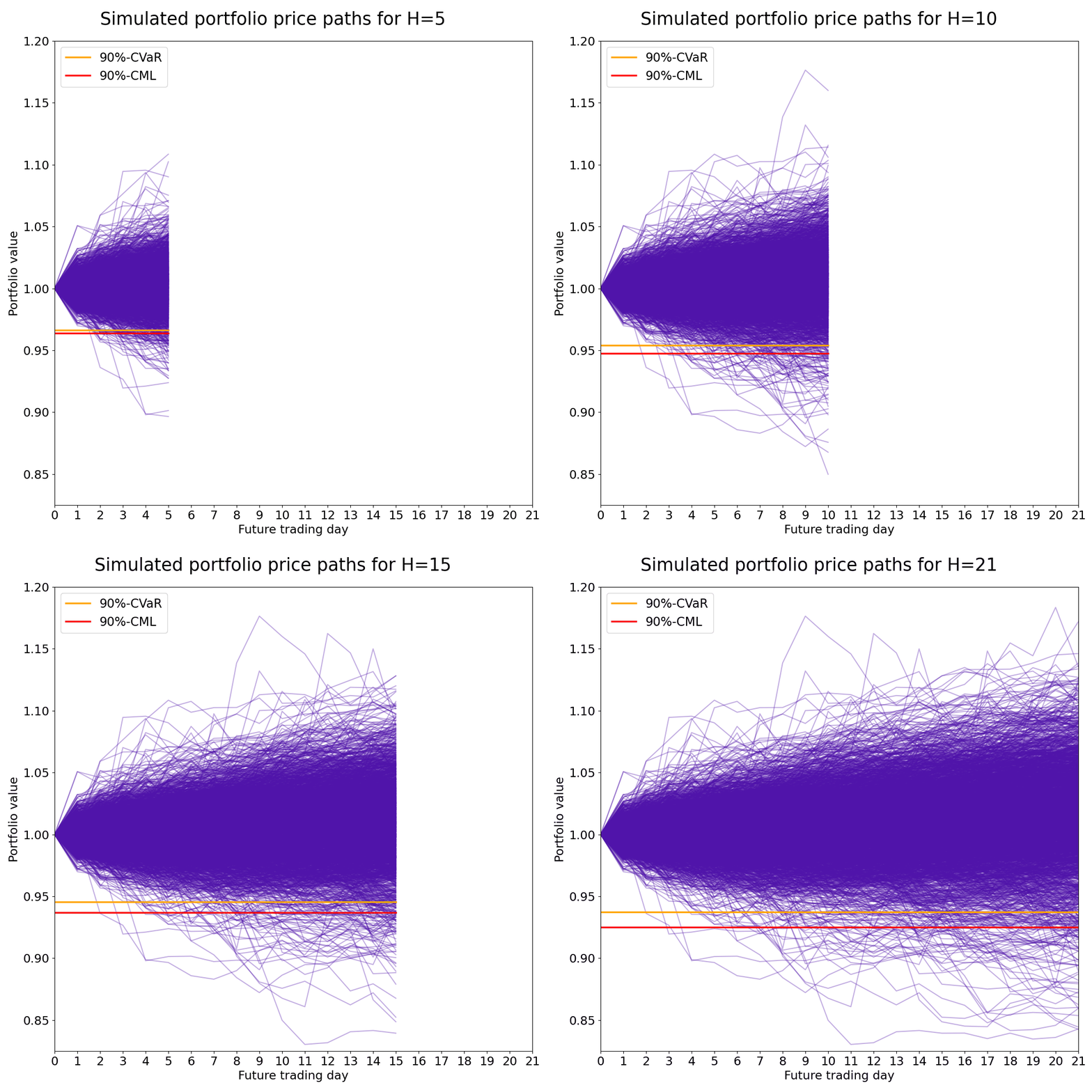
The Conditional Maximum Loss (CML) is a brand new investment risk measure, which is a natural generalization of the Conditional Value-at-Risk (CVaR) in a multi-period setting.
CML is a dynamic investment risk measure that aligns with how investment managers think about “drawdowns” in their daily work.
You can read much more about CML in the latest version of the article, which is attached as PDF at the bottom of this post.
See also this post announcing the Conditional Maximum Loss (CML) investment risk measure, and this post presenting a high-dimensional CML portfolio optimization case study.
Finally, see the Portfolio Construction and Risk Management book as well as the Applied Quantitative Investment Management course for more relevant methods and perspectives.
For a collection of my other scientific work, see the Science tab.
Abstract: This article introduces a new investment risk measure designed for the Fully General Investment Framework (FGIF), which is centered around fully general Monte Carlo simulation paths and their as sociated probabilities. The new risk measure is coined Conditional Maximum Loss (CML). It draws inspiration from drawdowns but adjusts for their practical shortcomings. The CML risk measure focuses on the expected loss over the entire horizon between portfolio rebalancing times, not just the losses at the end of the rebalancing horizon. CML portfolio optimization problems can be solved using linear programming, similar to the popular Conditional Value-at-Risk (CVaR). In fact, we can formulate joint portfolio optimization problems where both CML and CVaR are minimized, while the portfolio’s expected return is maximized. This allows investment managers to both optimize the distribution at the end of the investment horizon as well as the portfolio’s path, making the portfolio more robust and minimizing the probability of experiencing stop losses or client withdrawals. The Python case study includes several practical examples of how the new investment risk measure can be optimized in combination with Sequential Entropy Pooling (SeqEP) views and stress testing.
Keywords: Conditional Maximum Loss, Expected Maximum Loss, CML, EML, CVaR, CDaR, portfolio optimization, investment risk measure, portfolio construction, risk management, linear programming, Fully Flexible Resampling, FFR, Sequential Entropy Pooling, SeqEP, Python Programming Language.
Suggested Citation: Kristensen, L. and Vorobets, A., Conditional Maximum Loss Portfolio Optimization (January 30, 2026). Available at: https://antonvorobets.substack.com/p/conditional-maximum-loss-article

The Conditional Maximum Loss Portfolio Optimization Python code is available here.
Video walkthrough
You can watch a video walkthrough of the Conditional Maximum Loss Portfolio Optimization article and its accompanying Python code here: