
Normal Distribution Myth Article
This post contains the latest version of the Normal Distribution Myth article by Anton Vorobets.

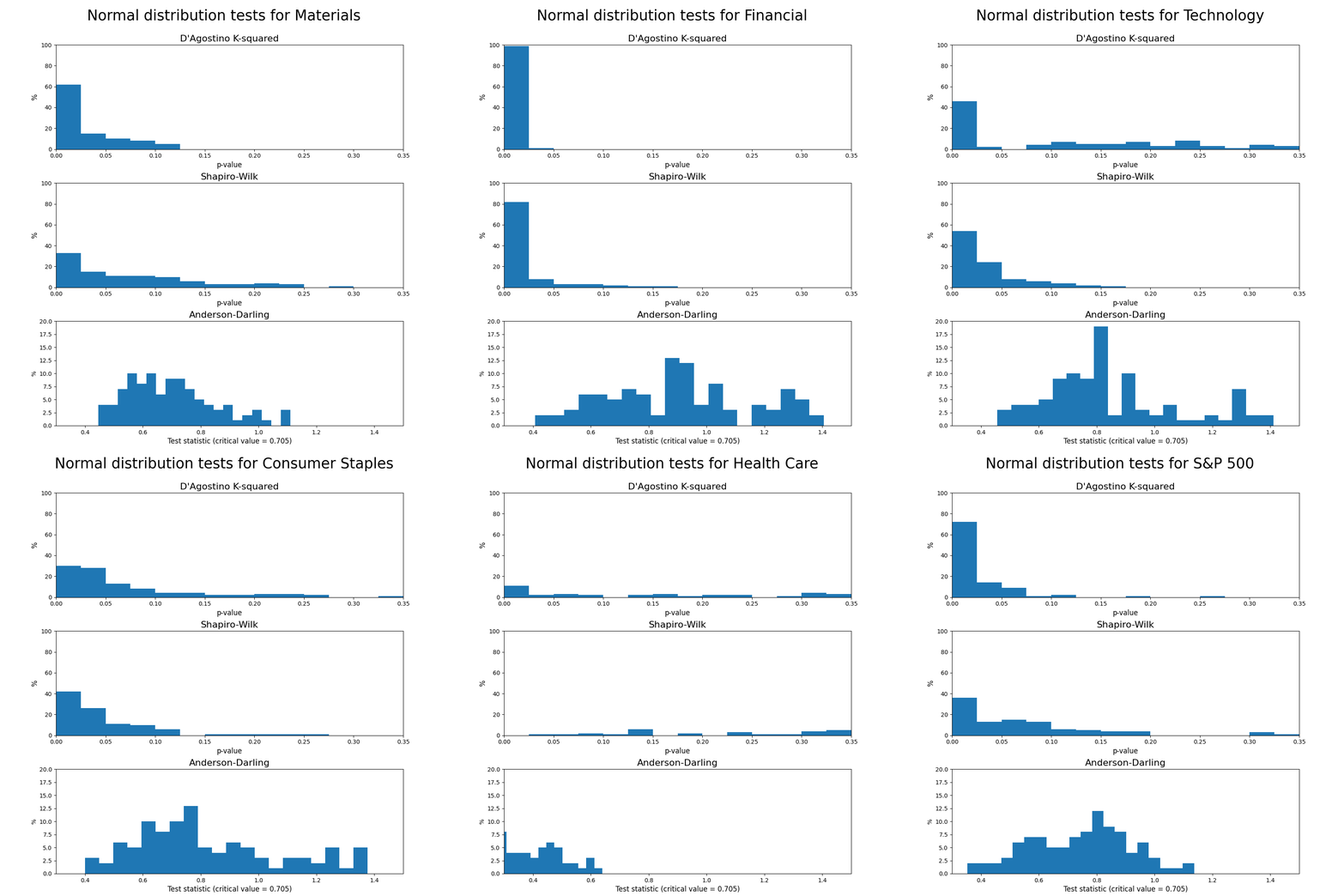
As explained in Chapter 2 of the Portfolio Construction and Risk Management book as well as Lecture 2: Stylized Market Facts from the Applied Quantitative Investment Management course, empirical return distributions are very far from being elliptical.
However, some academics keep insisting on the existence of a phenomenon referred to as “Aggregational Gaussianity” (AG). This idea comes from a misuse of some undefined central limit theorem (CLT), where log returns should supposedly converge to a normal distribution on longer horizons.
The Normal Distribution Myth article, latest version available in the PDF below, formally tests this claim on various horizons, rejecting the hypothesis that log returns become normally distributed on longer horizons.
Another important point is that for portfolio optimization, risk decomposition and performance evaluation, we must use discrete returns that sum over portfolio exposures. Hence, log returns are mainly a computational convenience for simulation because they sum over time.
Finally, we should remember that it does not really matter if the marginal return distribution of some instrument in our portfolio is approximately normal. To justify methods like CAPM, Black-Litterman and mean-variance, we need joint normality, which is even further away from reality due to differences in “risk on” and “risk off” dependencies. Hence, the Fully General Investment Framework (FGIF) does not rely on any such simplifying assumptions.
Abstract: This article busts the myth about empirical asset returns following normal distributions. Such arguments are sometimes made by finance and economics academics based on a misuse of some undefined central limit theorem (CLT). The case study performs several formal tests for normality of 10 US equity index returns on various horizons, illustrating that the assumptions underlying the CLT apparently do not hold for real-world investment returns. Hence, the overall conclusion based on a CLT argument cannot be made. The article concludes that simple empirical analysis of historical investment returns shows that markets do not follow normal distributions, or even more generally elliptical ones. Building investment portfolios based on such oversimplifying assumptions, effectively ignoring the empirically observed fat left tails and risk-off dependencies, can lead to disastrous outcomes and should therefore be avoided in practice.
Keywords: Normal distribution, central limit theorem, Aggregational Gaussianity, mean-variance, investment returns, normality tests, Shapiro–Wilk, D’Agostino’s K-squared, Anderson–Darling, stocks, fat tails, skewness, kurtosis, Sequential Entropy Pooling, CVaR, Python Programming Language.
Suggested Citation: Vorobets, A., The Normal Distribution Myth (June 05, 2025). Available at: https://antonvorobets.substack.com/p/normal-distribution-myth-article

The accompanying Python code for the Normal Distribution Myth article is available here.
Video walkthrough
You can watch a video walkthrough of the Normal Distribution Myth article and its accompanying Python code below: