
Fully General Investment Framework (FGIF)
June 2026 edition of the Portfolio Construction newsletter, summarizing the Fully General Investment Framework (FGIF).

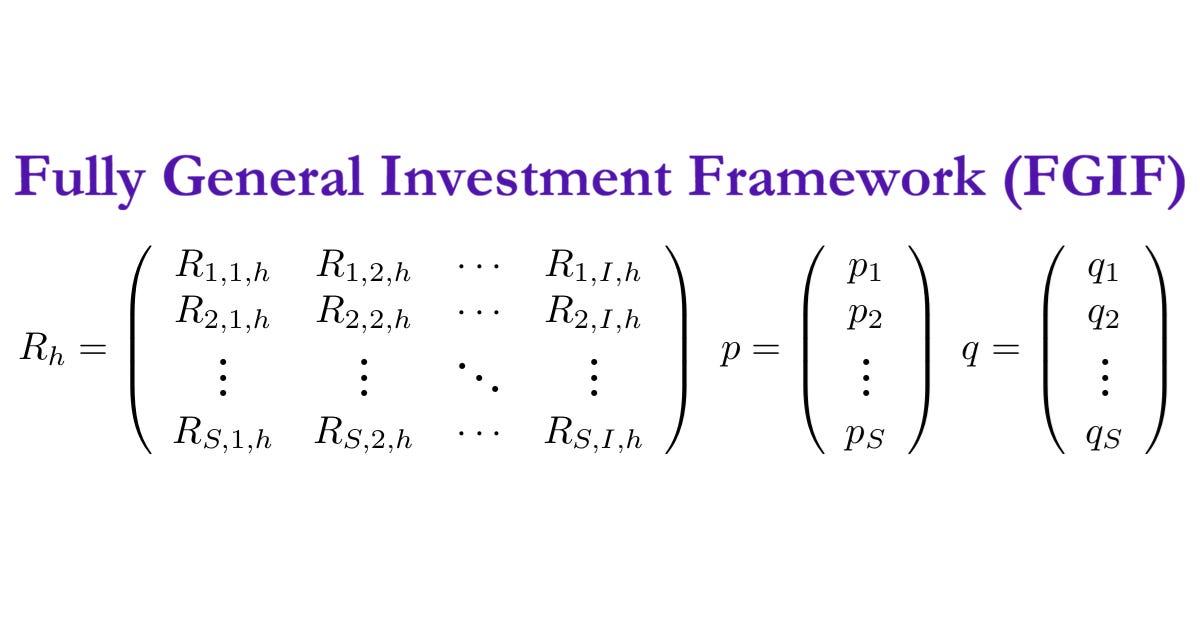
This newsletter summarizes what is actually meant by the Fully General Investment Framework (FGIF).
The name comes from the fact that its core consists of fully general Monte Carlo paths:
and their associated path probabilities:
see Section 1.1. from the Portfolio Construction and Risk Management book.
The inspiration for the Fully General Investment Framework (FGIF) undoubtedly comes from Attilio Meucci’s work, who tends to refer to the one-period version as scenario-based or probabilistic.
However, since Attilio Meucci’s earlier work, many important, albeit sometimes subtle, innovations have been introduced.
First and foremost the Sequential Entropy Pooling (SeqEP) approach, which tends to give significantly better results than the original Entropy Pooling (EP) and allows us to solve practically-relevant views and stress testing problems. Prior to SeqEP, EP did not get the attention that it deserves.
Second, the Causal and Predictive Market Views and Stress Testing framework, which works for the fully general Monte Carlo paths presented at the beginning of this article.
Finally, the Conditional Maximum Loss (CML) investment risk measure and its optimization are significant innovations that solve many practical problems and generalized Conditional Value-at-Risk (CVaR) to the multi-period setting.
Resampled Portfolio Stacking, Fully Flexible Resampling (FFR) and the Portfolio Management Framework for Derivatives are additions that are also worth mentioning, although they are perhaps a bit simpler conceptually than the first three.
Common for all the above methods is that they work for fully general distributions and historical market data paths. So, when we talk about the Fully General Investment Framework (FGIF), we mean all of the above in combination, not just the Monte Carlo paths.
As a paid subscriber to the Quantamental Investing publication, you have the best opportunity to thoroughly learn about all the above methods through the Applied Quantitative Investment Management course and the chat Q&A.
Popular posts recap
Below is the popular posts recap since the previous newsletter.
Why large organization use does not justify an investment method:
Why AI is not currently able to solve novel programming problems:
Comparison between CVaR and variance optimization:
https://www.linkedin.com/feed/update/urn:li:activity:7461033594963148802
Fundamental differences between Entropy Pooling and Relevance-Based Prediction:
An easy way to handle derivatives in portfolio optimization, risk decomposition and performance evaluation:
Practical examples of Conditional Value-at-Risk (CVaR) risk budgeting and diversification:
https://www.linkedin.com/feed/update/urn:li:activity:7465747635409362945
Multi-period hedging of liabilities with Conditional Maximum Loss (CML):